Strawberry Fields Forever: The Search for Harmony in Chaos
John Lennon's Emotional Home in the Mixolydian Mode

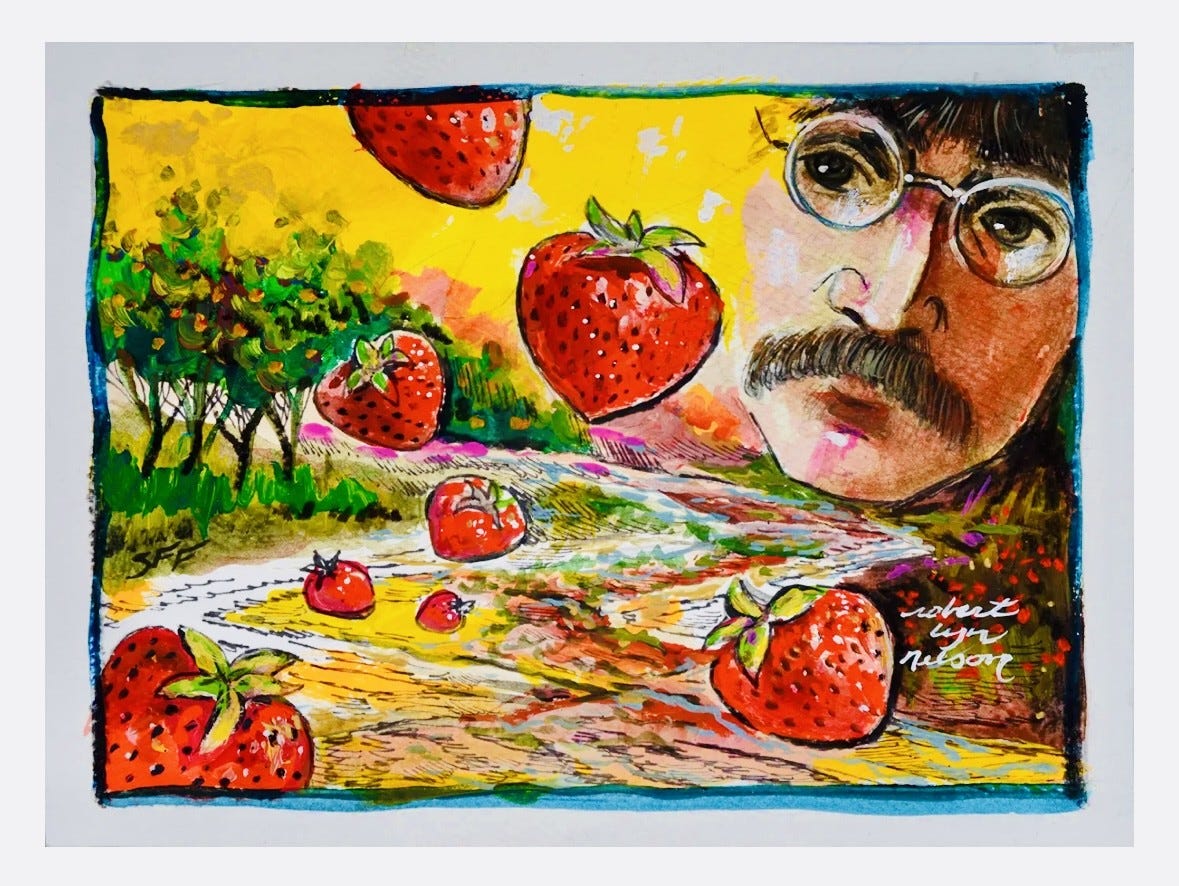
The other day, sitting at the piano and playing Strawberry Fields Forever while staring out the window, I found myself wondering why John Lennon so often gravitated toward the Mixolydian mode, why that particular sound kept returning in his music as if it were less a choice and more a place he lived in. It began to feel like the mode mirrored his inner world. Lennon seemed to move through life with a constant sense of longing, a quiet distrust of comfort, and an awareness that beneath beauty there was always something tender and unsettled. The Mixolydian mode sounds like remembering childhood while knowing it’s gone, and that, in many ways, is Lennon’s emotional signature. Where Paul McCartney wrote toward beauty as something that can be arrived at and held, John Lennon wrote from inside memory and fracture, from within the pain of knowing and not knowing at the same time. Mixolydian gives light without false happiness, sadness without despair, and truth without resolution.
As his world expanded in the mid-sixties through psychedelics, meditation, and encounters with Eastern philosophy, his thinking loosened its grip on straight lines and destinations. Those explorations dissolved goal-oriented movement and replaced it with cycles, loops, and inward turns. Experience became less about arriving somewhere and more about unfolding moment by moment. The Mixolydian mode is perfectly suited to that state of mind. It carries the openness of a major key but softens certainty with a flattened seventh, introducing a gentle unease, a sense of impermanence that never quite settles. Emotionally, it hovers between joy and loss, wonder and vulnerability. Happiness is present, but it never fully lands. “Reality leaves a lot to the imagination,” Lennon once said, and the Mixolydian mode seems to agree, refusing to resolve cleanly, lingering instead in ambiguity.
What draws someone to a sound like that is rarely technical. It’s recognition. Something in that harmony mirrors how the inner world actually feels. The flattened seventh weakens the pull toward arrival, loosening the promise that everything will come to rest. The music remembers joy without claiming it, beauty without stabilizing it. That hovering, that refusal to settle, was Lennon’s home. Strawberry Fields Forever doesn’t really move forward; it circles inward, like a thought returning to itself, like childhood recalled through the haze of adulthood. Wonder is there, but so is disorientation. The song doesn’t try to resolve that tension. It allows it to be true.
There’s something here that reaches beyond music. Uncontained chaos is not freedom; it overwhelms and fractures. Absolute order is no refuge either, narrowing perception and clinging to certainty. Real exploration only becomes possible when there is a center strong enough to tolerate instability. In contemplative practice—whether meditation, creativity, or deep self-inquiry—this becomes obvious. As attention steadies and presence deepens, trust begins to form, not in answers or outcomes, but in the ground beneath experience itself. And paradoxically, that ground turns out to be groundless.
When you rest in that quiet confidence beneath thought, experience can become strange without becoming threatening. Emotions can intensify, meaning can loosen, old structures can wobble, and nothing essential collapses. Chaos is no longer something to escape; it becomes something that can be held. This is the strange discovery that comes from familiarity with openness: grounding does not come from fixed certainty, but from knowing you can remain present when certainty dissolves.
Lennon lived close to that edge. Sometimes it wounded him, sometimes it produced extraordinary beauty, but he kept returning because it felt honest. And that honesty still resonates. All of us live inside inherited structures—psychological, cultural, emotional—that give coherence while quietly confining us. Somewhere beneath them is a longing to loosen the frame without losing ourselves. The Mixolydian mode gives sound to that longing. It reminds us that freedom doesn’t require abandoning form, only softening our grip on resolution. Harmony becomes deep enough to allow distortion; certainty relaxed enough for truth to breathe. This is not just how great music works. It is how consciousness learns to evolve, loosening its grip on resolution, hovering and circling, resting as the open ground in which experience arises and passes, and somehow feeling more real because of it.
Great article from another one of us JL fans. I’ve written about the perceived comfort of the family and cultural matrix which keeps us bound within countless forms of our “Ring Pass Not” until we choose to step outside of the walls of the castle and experience the uncertainty of freedom. That’s the mark of an artist, who ultimately brings harmony out of friction.
John’s uncertainty and his lack of need for concrete resolution gave us many hours of musical joy, whether in song or his life. Over the years, I’ve seen many criticisms of his embrace of chaos as an art form; some of his “adventures into chaos” worked better than others. But he never played it safe.
There was nothing formulaic about John. That’s the mark of a true artist. It seemed like each of his songs after 1965 went into new areas of expanding the safe into the uncertain.
I still marvel at what he left for us in such a short time. And yes, he made a fine art of moving in and out of “safe expectations” to create the life and music which still generates articles like ours.
I really enjoyed reading this, especially the way you framed the mixolydian mode as a kind of inner language for Lennon, something he could not quite articulate in words but found in sound. That struck me deeply. It makes me think about how certain musical choices resonate with listeners not just intellectually but almost at a subconscious level, aligning with something unspoken inside ourselves. It is a reminder of why songs like Strawberry Fields Forever feel timeless: they do not just tell us something, they reveal something we already carry within.